

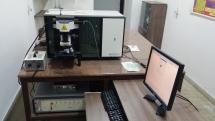
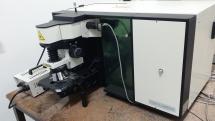
HORIBA JOBINYVON LABRAM 300
SPECTROGRAPH
300 mm focal length; Gratings with 1800 gr/mm and 600 gr/mm
SPECTRAL FEATURES
Resolution: from 2 to 4 cm–1; Low Frequency Measurement: from 30 cm–1
LASERS
Internal: HeNe 17 mW (632.817 nm); External: Nd:YAG frequency doubled 50 mW (532 nm)
CONFOCAL HOLE
Adjustable between 0 and 1500 μm
MICROSCOPE
High stability: BX41; Olympus Objectives: 10x, 50x, 100x, 50x LWD, water immersion 40x
SAMPLE HOLDERS
Manuel stage; Automatic XY microscope stage for point-by-point imaging/mapping
FIBER OPTIC
Laser coupling into a fiber optic when using a super head
Raman spectroscopy is a spectroscopic technique based on the inelastic scattering of monochromatic light generated by a laser. Inelastic scattering means that the frequency of the photons from the monochromatic light changes upon interaction with the sample being analyzed. The photons from the laser light are absorbed by the sample and then emitted. The frequency of the emitted photons is shifted (higher or lower) in relation to the incident monochromatic frequency, which is referred to as the Raman effect. This shift provides information about the vibrational energy changes in the molecules. The obtained Raman spectra provide detailed insights into the molecular and structural composition of a wide range of materials, enabling precise identification and characterization through their unique vibrational signatures.
The laboratory is open for collaboration with academic, innovation, and industrial institutions and firms.
Analysis capabilites:
The laboratory is primarily used for research purposes but also offers opportunities for practical applications as it provides:
Contact:
Prof. Dr. Petre Makreski
Phone: +389 70635839
Email: petremak@pmf.ukim.mk